The Mythos
Mirage of Blaze's lore and concept draws it's influence from Buddhist tradition. It doesn't rely entirely on the philosphy but instead uses it's figures and reframes the idea into a more supernatural interpretation. There is however some traces of philosophy and traditions sprinkled through the series. The story itself carries a heavy tragic narrative, highlighting suffering, attachment, karma, and the cyclical nature of life and existence.
You could say samsara (the cycle of death and rebirth) is one of the key aspects within the series. The warriors of Mirgae of Blaze are traped in a continuious cycle of reincarnation, bound to their past as they are granted the ability to keep their memories with each new life, this could be seen as both a blessing and a curse. This also can indicate various forms of strife within their character traits. Naoe's maddness is one example of damaged experience living for over 400 years tormented by his own desires and the struggle he undergoes to surpress his desire of conflicting love and hate towards Kagetora. The layers of love, hatred, betrayal, and guilt spand over several lifetimes which is what gives the characters such tragic challenges.
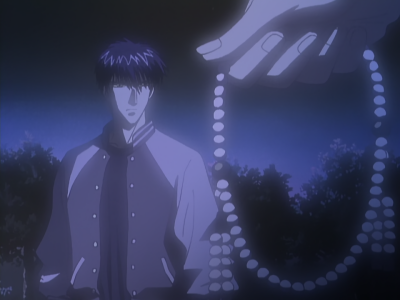
There are much more concepts intertwined within the series but I just want to touch up on the key points and a few of the major corresponding elements. Like I said Buddhism itself is not used as a religion within the series, however we do see monks and minor characters (as you would with a story set in Japan.) who do follow the path. The framework of Mirage of Blaze uses Buddhism more as a kind of blueprint drawing upon things like cosmology and various other inspirations, using sutras, incantations, even mala beads and prayer beads can be seen used as well as talismans and charms imbued with spiritual energies. You could even say reiki is also hinted within the universe since the characters do use a form of spiritual energy to do battle with entities, such as onyru and various other supernatural forces.

One of the most important elements we see throughout the series is the Yasha-shuu who's powers are channeled through the war god Bishamonten. Bishamonten is their guardian deity as we see through both the novels and the anime adaptation, the Uesugi chant sutras and incantations harnessing the power of Bishamonten in order to exorcise their enemies. I won't go into to much detail with Bishamonten, but I will say he is one of the most important and powerful deities within both Buddhism and Shinto religions. As one of the four heavenly kings it would make sense why he would be the one the Yasha-shuu would associate themselves with, as he represents righteousness and duty.